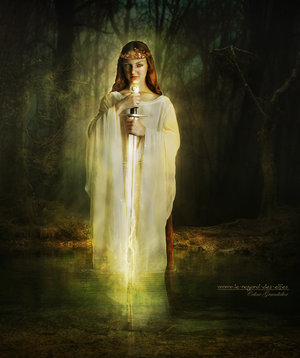
By David Outeiro
I remember the first
time they told me about an encounter
with her ...
It
was one of the
first afternoons
of the autumn of
2011. I had the
idea of visiting
the hill fort of
Pena Rubia,
where an
altar devoted to the goddess Návia
appeared. Drove
my Terrano
as usually
because that day,
like so many others, I would have to go to
an area where
only four-wheel
drive vehicles could reach and
so I came to the
vicinity of the
Minho River,
which in those days
had little
water. I used a
road that went through a
beautiful Oak
forest, crossed
to the other
shore and soon
I was able to clearly
see the hill fort, even before
seeing the
sign that
indicated that I
was entering in it. At
the entrance of
the ancient Celtic city
there was a
granary with
a Celtic cross
and a rooster by
its side. Near
the hórreo (old granary)
there was an
elderly man sitting,
looking at me;
my intuition
led me
to make a stop
and so I parked
my car. I sat on
the bench where
he was and we started
talking, he told
me of a
concern that I
shared, the fact that many weeks have
passed without
rain, a situation
that had left
everything dry.
We continued to
talk and he told
me that
at the time he
was the owner of
the hill fort but
he seemed to
know nothing about
the altar to Návia ...
or of any stone
with engraved
letters, since I used those
same words to ask
him the question.
The man told me about a mamoa (megalithic
funeral monument) that I was
looking for me
and he signaled
the top
of a mountain.
When the
time came for me
to go, it
was already a bit
late and I still
had to climb
to the top so
I said goodbye
telling him that I would come to see him
again.

It didn’t
take me long to
go back there
and I was so lucky that I found the man
again in
that same place, the slope
that leads to the
hill fort. I
went to talk
to him again, to
greet him and the
conversation lasted
for a long
time. I asked him
about the legends of
the area, but
he said he didn´t
know any. But,
there was a
moment when he
told me: "....
but yes,
there are some tales."
I listened carefully
and he told
me of the people
of Pena
Rubia that had
listened to
the trasno (goblin); he also told me about
a "curse" affecting
a man that removed
stones from the
hill fort without
"gift from
the church"; he told
me about those
searching for
treasures in the
maounds of the area. I had
the perception
that what the man was telling
me were not
legends to him,
it was a
reality that was
transmitted in order to be told in front of
the fireplace
... When
the conversation was
drifting into
different things, thanks
to the increased trust;
he ended up telling
me of an
encounter with a
mysterious and powerful
woman. He
was telling the story
of a man settled
in that area that
was walking
through one of the paths of
those hills. For
once, he witnessed
something strange:
a woman appeared
in the middle of the way
sitting while
sppining. The man
could not pass
what so he said
to the woman in a sort of
rude manner:
"Step away
or I
will move you
away!?” The
woman refused to
get out of
the way, stood up
and began
fighting with the
man. While
they were fighting
they started rolling down the slope
to the river.
The man
realized that he would probably lose as he
realized that
this was a supernatural
woman and
so he began
"making
crosses." By
making the
crosses, the
man managed to
free himself from her.
Angrily she replied that:
"If you
had not “made crosses”, I would have
killed you."
This was a
woman who spun
(the fate of
men), a powerful
warrior who led
the men
to the Beyond by
crossing the river!
...

A pagan
woman who
only Christianity
(crosses) could
stop ...
although she
was still there! She was Návia
Corona!
Morrigan!, The
warrior goddess
and augur of death!.
That man did
not know the altar,
but it seems that
someone in the
same place where
the tomb
appeared
encountered the
same goddess!
We will continue to
complete our
puzzle ...
There
is a beautiful romance
gathered in Cerdedo
in the
year 1904 by
Vítor Said
Armesto of
an old beggar
called Luzia
Domingues. The
romance that became a
music by "Fuxan
os ventos"
talks about of a
mythological figure,
“ a Lavandeira”( the laundress)...
it says:
In
Galician
mythology, the
Lavandeira is a
female spirit, a
supernatural woman
who belongs
to the other side,
to the other world.
This apparition
manifests itself
at the edge of
rivers or even in
washhouses. It
is a fearsome-looking
woman, old and
wrinkled according to what some say. Emits
horrible voices,
laments and screams
... while
washing bloody clothes.
This is the
clothing of those who
will die soon;
the Lavandeira
brings augurs or omens of death, so her
warning is
feared. When she
is found, this apparition
can ask for help washing the clothes to
those who find
her. In
case of accepting
the petition the
unfortunate should
drain the clothes by twisting them the
opposite direction to the one she chooses, if they
do it in the same direction their deaths
will be sure
and she will
eventually lead them
to the
other world, the Beyond.

On
the island of Ons,
on the cost of
Ogrobe, stories
are told of a man who
dared to come
close to
the Lavandeira,
more than one in
this case,
because he found three women
washing their
clothes one night.
He got closer out
of curiosity and
asked them
what they were doing
washing their clothes
at those hours.
One of them stood
up and picking
the man by
his clothes threw
him effortlessly into the thorny bushes.
Fear paralyzed
him in
such a way
that he
stayed there all night until
the neighbors got him out of there in the
morning. In
Ireland there is
"the
Washer-Woman
at the ford"
(Lavandeira do vão) or
the Banshee
(Women of the
Sidh). The
Banshees like
our Lavandeiras
are an augur of
death. They also
wash their
clothes full of
blood producing
the same laments and screams. They may
appear as young,
beautiful women, like a dame
or as a
fearsome old
lady, a curious triple aspect
of the goddess
similar to the apparition on the
Island of Ons.
She can also
appear in the
form of a viaraz
raven, stoat,
hare or
weasel. The
banshees have the
particularity of
being linked
to some important families.
When someone from
the family
is about to die,
the Banshee
associated with the clan
starts crying.
The apparition
of several
banshees at the
same time indicates the death of
someone important
or sacred.In
Scotland is
known as the Bean
Nighe or
Nigheadaireachd.
They also appear
washing clothes
in rivers or
lakes of
those who will
die. They have
some curious
particularity,
sometimes they
appear with
palmed feet like aquatic birds. In
Celtic beliefs,
such birds
are related to messengers from the Beyond.
Perhaps because of
the nature of
birds and
the fact that they live in
an aquatic
environment, they are
in the threshold of the Beyond.
If someone
can breastfeed
from her chest, that person will become her adopted son and
can make a wish,
such as knowing
the name of those
who will die.
The writer
Dorothy K.
Haynes tells
a story of an
encounter with
one of these
women that
happened to a girl
named Mary.
One day the
young girl was returning
to her home when
she heard a noise
in the river. She
thought she
would find her
mother washing
clothes but
instead she found a
woman with a
harsh face with small palm feet like a duck.
Carefully Mary
tried to get closer
but the woman hit
her. Because of
that, Mary's
legs were
paralyzed and
she could not
walk having
to stand still in the path. Her
mother managed to
find here after
an agonizing search
and took
her home. The
story has a
tragic end with
the death of Mary.
The Bean
Nighe ...
was washing the
clothes of
that same girl.

In
Wales she is
known by
the name of Cyhyraeth
(ghost or
skeleton). It
is an augur
of death that
emits a
voice that sounds
three times,
a triple warning
that is
pronounced with
less intensity
each time. Here
we can also find reference to the fact of
having to wash
the clothes in
the opposite direction to
the one of the
person who can
find her. In
doing so you are
granted 3
wishes.
In
the Armorican Brittany she is know under
the name of Tunnerez
noz. Like
other similar apparitions,
she washes in the river the clothes
of those who will
die, waiting
for someone to fall into
the trap so
that they can be taken to the Beyond.
As
we can see, these
apparitions have
identical or very
similar
characteristics
in the Celtic
lands of
Galicia, Scotland,
Wales, Ireland
and Brittany.
But
now it is time to
unveil the
identity of the
ancient
Lavandeiras.
According to the
sagas of the
Celtic warrior,
the hero Cúchulainn, Badb
presented itself to him
before the last
battle of the
warrior as an augur
of death.
Cúchulainn will
face his
last battle, when
it’s said;
"Not
far away from the castro
(of Emain
Macha) they
found a beautiful
damsel, well
proportioned, in
front of Áth
in Foraire
in the chaira
of Emain
that was moaning
and complaining
at the same time while
crushing and
washing red remains of chunks of meat
of wounds on
the side of a ford. "
The
druid Cathbad
interpreted this
as an omen and
told Cuchulain
that the woman is
Ingin Baidbhi,
daughter Badb,
and that the
washing and
yelling are
augurs of his
death:
"-Small
dog-says Cathbad.
Do you know what
the girl is
doing? She is
washing your
clothes. Her
cries and
screams while
washing your clothes are her way
of expressing your
death when
you face Medb's
army. Take my advice
and go
back.
-Dear
master ...
I deeply appreciate
your advice, but
you know, like I
know, that my
end is near and
I'll go
down fighting. Do
not to
make me avoid it,
because if
I join this battle or not, my death fighting will be near
anyway.”
There
is another saga
that speaks of
King Cormac
and where Badb
also appears
bringing augurs of death. The following
quote is
from the saga
"Togail
Bruidne Da
Choca":
"...
Cormac Connloingeas,
son of Conchobar
mac Nessa,
king of Ulster,
is on his way
from Connacht
to Ulster to
be crowned after
the death of his
father and like
Cúchulainn, fate
forces him to
break during the
trip several
geissa (taboos)
that the druid
Cathbad had told
him when he was born. When
he and his 300
followers arrive
at the River
Shannon, they find
a red woman on
the side of a
red ford, washing
her chariot of war,
the seats and
the harnesses.
When she lowered
her hand,
the river water
turned red.
But when she
lifted her hand
over the top of
the water, not a drop remained
in the river, since all the water was
raised allowing them to cross the river without getting
the feet wet ".There
is a story of war
much more recent, which took
place in
Scotland. In
the "Cáithréim
Thoirdhealbhsigh"
we can find the
Battle of Dystert
O'Dea that
took place on May
3, 1318 where
Badb
appears:
"Richard
de Clare, the
chief of the Normans,
was heading to what he believed
would be
an easy victory
over the O'Deas
Dystert. When
he and his army
were ready to
cross the River
Fergus, they
saw on a ford of the river a horrible Badb
washing the
armors and
luxurious covers
that had red blood falling that dyed
the waters of
the river. De Clare
asked an
Irish interpreter
to ask the woman to whom these armors
and clothing belonged.
She replied
"they were
armor, robes
and other
garments from
Clare himself, his
children and the
rest of his
followers, many
of which would
die soon." The woman identified
herself as “In
Dodárbrónach-
the dark of the waters" .
De Clare then
gave order to ignore the woman, saying
that she had come
to benefit
the Clan Turlough
stopping the
expedition against
them. Finally
the prophecy
would be
fulfilled and
De Clare and
his men were
defeated and
killed ...
"

The
"Cáithréim
Thoirdhealbhsigh"
also speaks
of the appearance
of the
Badb in the
battle of
Corcomroe Abbey,
North Clare, on
August 15, 1317.
The
Irish king is
visited by Aoibheall,
a Badb.
Quoting Manuel
Alberro in
" Diosas
celtas"(Celtic godesses):
"In
a XII century description
of the Battle of
Clontarf (1014)
that ended
the war with
the Vikings and
their power in
Ireland,
Aoibheall
appeared to
Brian Ború,
Supreme King of
Ireland, the night
before the
battle, and
predicted that he would
die in this
battle, and that the
first of his
children that he would
see in the
morning of the
battle would be his
successor and
the next king.”
We
said before that
Badb presents
itself in the form
of a laundress (Lavandeira) woman but, as
its name suggests,
it is also a
viaraz raven. In the Galician beliefs
the raven is a
beast of ill
omen, because
it’s a messenger
of the Beyond that
can announce
death. There is
also the belief
in the "bird
of death",
which presents
itself during the night, complaining, speaking with a mournful
voice or singing.
The owl can
also give this
warning .Says
Taín Bo
Cuailnge:
"The
Morrigan assumed
the form of bird
on a vertical rock
that was in
Temair Cuailnge.
And he
said (the
Dom
Cuailnge);
(...)Ravens
over the bloody bodies, plains
full of dead
warriors, heroic
warriors
slaughtered by
dust, endless
war, cattle
trampling,
battles in
Cuailnge the
ominous laments
of Badb
in the twilight
of the battlefield,
dead children,
dead husbands,
dead comrades,
death! death!
"
The
goddess also
appears to
Cúchulainn on
one occasion in
the form of a
raven, saying
the warrior:-The
appearance of
a bird
in this place is
very bad
omen!
We
also know that
the death of Cúchulainn
comes (after
the apparition of
the Lavandeira)
when a
raven lies on top
of him.

The
goddess of death
appeared before
the hero over
the course of his
life with
a positive
purpose on one occasion:
"The
Morrigan, at
the time of
Cúchulainn, was
accustomed to
interfere in the
affairs of Ireland,
instigating wars
and fighting’s.
She was
the one that raised
Cúchulainn on
one occasion, when
he was very
young, over
his bed and
when he was about
to give in to the
magic spell used against
him. "
As
we can
observe, Morrigan
(Great Queen),
Badb (viaraz
raven) and Macha
(A chaira)
are three "grim"
manifestations of
the same goddess.
A goddess that
does not participate
directly in
the war but
interferes with the
end results with her magic in the shape of a viaraz raven.
The one that brings
augurs of death
and usually appears
in the form of
a Lavandeira
(laundress). A
goddess closely
linked with death
and therefore with transformation,
rebirth, and the
end of a cycle.
Her connection to
waterways is
clear, because in
the Celtic
world they
represent a
threshold, a
boundary that
allows us to make
a transition to the Beyond.We
see the
obviousness of
being a common
divinity in
Celtic religions.
So, the
Lavandeira also
appears in
Galicia, as the
result of a
common origin. In
my opinion,
this is the identity
of Návia
that in an altar is accompanied by
the epithet
Corona, ie,
female leader of
an army. That's
why there are
also rivers
with her name,
because that
was a
place of transit
to the Beyond
where the
goddess could
appear. In the next articles we will speak
of many more
evidences.
In
Gaul she appears with the name of
Cathubodva Bodua
and may be the
same Nantosvelta
which has been
represented in association with the viaraz
raven.
Millenniums
and centuries went by and today in
Galicia, the Morrigan,
the Great Queen
continues to be present.
Note:
There is confusion
about the association
of Badb with the
corvids. The
crow (Corvus
corax) and
the viaraz raven
(Corvus corone)
are not the same
species. In my
opinion, Badb
is associated with
Lugh and to
the Corvus corone
and Lugh to the
Corvus corax,
of larger size.